career-ops Review

8.7/10

Run a local AI job-search pipeline inside Claude Code, Codex, OpenCode, and similar CLIs.

Review updated July 2026 By The AI Way Editorial 3 min read
career-ops CLI Tool Open Source Privacy Focused Recruiting Free

Our Verdict

career-ops is strongest for technical job seekers who want to filter roles before tailoring anything. The local setup, published rubric, and portal scanning beat a browser ATS checker when you care about control and privacy. The trade is real terminal work, so the value rises sharply if you already live inside coding CLIs.

Official site
Free to start.
open_in_new Try career-ops

What people keep saying about it

The GitHub traction is now hard to ignore: the homepage says 62K+ stars and 4,300+ Discord builders. The enthusiasm is strongest among technical users who like the local-first stance; the hesitation stays the same for everyone else because setup is still the price of entry.

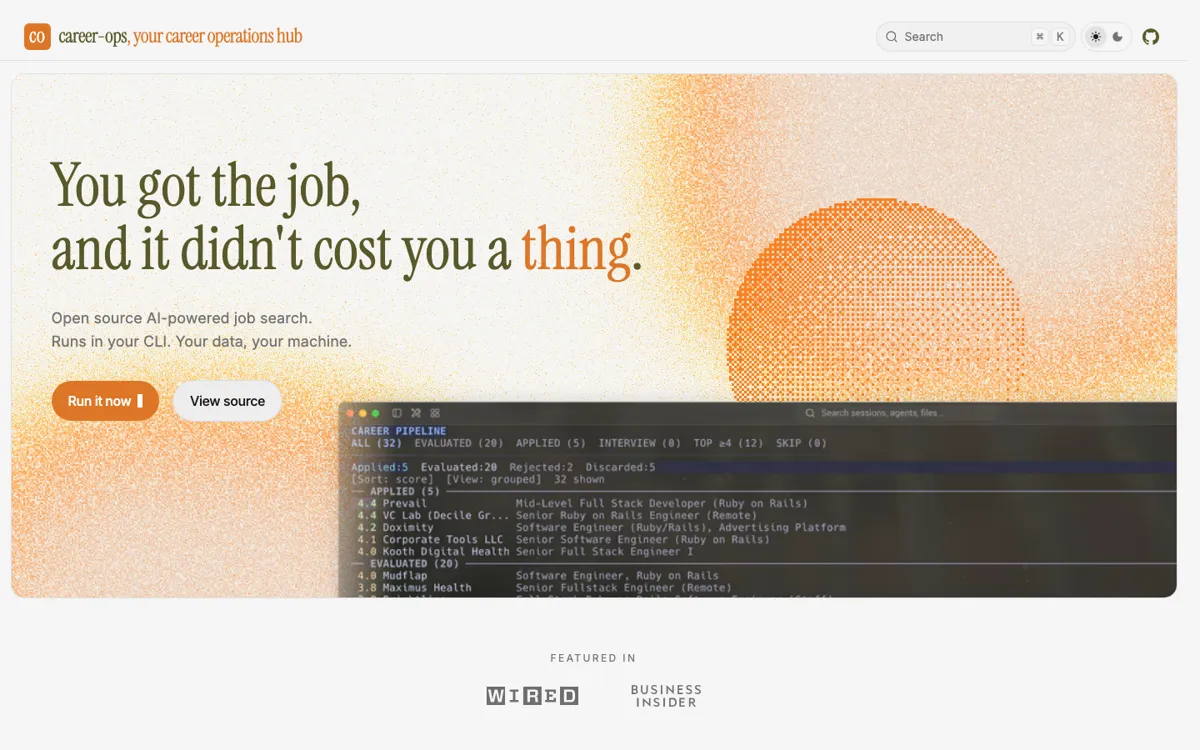
Official Website Snapshot Visit Site ↗

check_circle Pros

  • Local-first setup keeps CVs, reports, and tracker data off another SaaS account.
  • Published scoring logic is easier to audit than a black-box match score.
  • Apply mode saves time on the slowest part of serious applications: custom written answers.

cancel Cons

  • Setup is real: Git, Node, Playwright, local profile files, and an AI CLI all come first.
  • Non-technical users may still prefer a simpler browser product even if it does less.
  • The repo is free, but you still pay for whichever AI engine sits underneath it.

Should you use it?

developers and technical operators who want a local pipeline for role scoring and resume tailoring

Skip it if: you want instant browser convenience or a high-volume auto-apply tool with almost no review

Is it worth the price?

Free

career-ops itself is free and MIT-licensed. The real spend sits underneath it in Claude, Codex, OpenRouter, Ollama hardware, or whatever AI engine you decide to run.

The Free Tier

MIT-licensed repo with no paid tier, no account, and no telemetry.

One thing to know before you start

Do one full run with a real target role before scanning widely. If the score and tailored PDF do not sound like your actual story, fix the profile inputs first.

What people actually use it for

Decide whether a role is worth applying to

Paste a job URL or description and let career-ops compare it with your CV and target profile before it recommends apply, maybe, or skip.

Create a tailored PDF resume for one listing

Use the tailor and PDF flow when a role clears the threshold and you need a custom resume without overwriting the original CV source.

Draft open-ended application answers

Open a Greenhouse, Ashby, or Lever form and use apply mode to draft answers, then edit before submitting yourself.

What does career-ops actually do?

career-ops works best as a filter, not a spray-and-pray application machine. The published threshold logic gives you a reason to skip weak-fit roles before you sink time into PDFs, answers, and tracker upkeep.

The local setup is the real tradeoff. You get privacy, local ownership, and support for free AI engine paths like OpenRouter or Ollama, but only after doing the terminal work that a browser-first job tool avoids.

What you can do with it

Score job listings against your profile with a published 1.0-5.0 rubric.
Generate tailored PDF resumes without overwriting the original CV source.
Draft answers for Greenhouse, Ashby, and Lever application questions.
Scan 150+ company portals with zero-token portal discovery.
Track applications in a local terminal dashboard.

Technical details

data_model
Local-first with no cloud storage, no telemetry, and no account
scoring_system
Published 1.0-5.0 rubric with threshold filtering
supported_clis
Claude Code, Codex, OpenCode, Copilot CLI, Qwen, and more
portal_coverage
150+ company portals
free_engine_paths
OpenRouter, Ollama, local models, or free CLI tiers

Top Alternatives to career-ops

If career-ops is close but still misses the job, try one of these instead.

Key Questions

Is career-ops free?
Yes. The repo itself is free and MIT-licensed. The cost shows up only in the AI CLI or model access you choose to run underneath it.
Does career-ops auto-apply to jobs?
No, and that is part of the appeal. It helps you filter, tailor, and prepare, but the final submission decision stays with you.
What setup does it require?
Expect real setup: Git, Node.js 18+, Playwright Chromium, local profile files, a text CV, and an AI coding CLI. This is closer to developer tooling than to a browser signup.
How is it different from Jobscan?
Jobscan is easier for quick browser-based ATS checks. career-ops is heavier, but it gives you local ownership, published scoring logic, role scanning, answer drafting, and a fuller workflow around the application itself.