MiroFish Review

6.2/10

Run multi-agent simulations from seed material and get a prediction report.

Review updated June 2026 By The AI Way Editorial 3 min read
MiroFish AI Agents Autonomous Agents Open Source Self-Hosted

Read this first

Do not treat MiroFish's prediction report as a forecast you can act on without validation. It is a simulation engine, and public materials do not prove accuracy on real decisions.

Our Verdict

MiroFish is interesting because it does one unusual job clearly: turn source material into a multi-agent rehearsal of what might happen next. The upside is richer scenario testing than a normal chat tool. The downside is maturity: hosted access is still early, and self-hosting asks for real setup work.

Official site
Public pricing is not confirmed. Verify it on the official site.
open_in_new Visit MiroFish
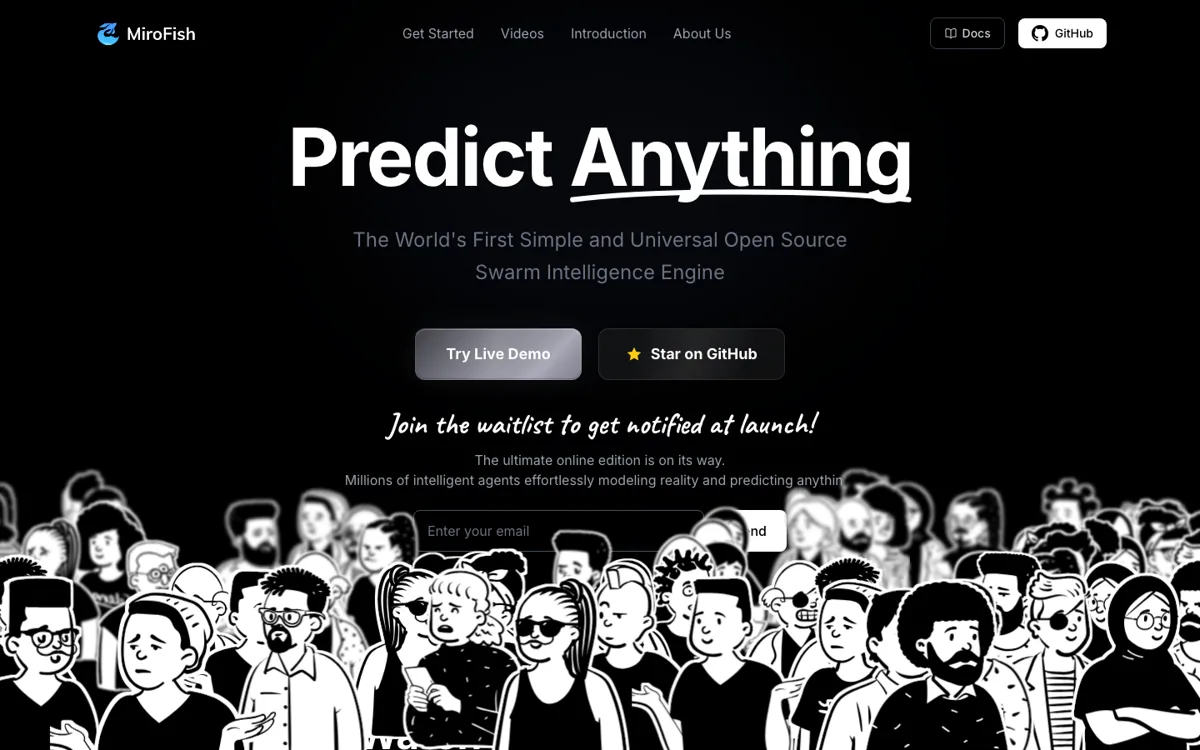
Official Website Snapshot Visit Site ↗

check_circle Pros

  • It turns a prediction question into a staged simulation instead of a one-shot answer.
  • You can inspect and keep chatting with the simulated world after the report.
  • Open-source traction gives technical users something real to inspect.

cancel Cons

  • The hosted version is still framed as waitlist-stage software.
  • Source deployment is technical and needs multiple services and credentials.
  • Public materials do not prove forecast accuracy for high-stakes decisions.

Should you use it?

teams rehearsing how audiences, investors, citizens, or characters might react

Skip it if: you need proven forecast accuracy and a polished hosted product today

Is it worth the price?

Pricing not confirmed

There is no public plan table or paid tier to compare. The practical cost is the open-source setup plus model usage, and long simulations can consume heavily enough that early tests should stay under 40 rounds.

One thing to know before you start

Start with a low-stakes scenario where you know the outcome or can compare later public reaction. If MiroFish cannot surface useful pressure points there, do not trust it on finance, policy, or crisis decisions.

What people actually use it for

Stress-test a PR response

Seed the simulation with a crisis event, audience context, and proposed response, then inspect how virtual groups and KOL-style agents react.

Explore policy reaction risk

Feed in a policy draft or public issue brief, then use the report to spot opinion clusters, likely objections, and risk points before launch.

Rehearse market sentiment

Use financial signals or market narratives as seed material, then simulate investor sentiment shifts before choosing what to investigate deeper.

What does MiroFish actually do?

MiroFish makes sense when the question depends on many actors reacting to each other, not when you just want a quick opinion. The input is seed material plus a prediction prompt. The output is a report and a simulated world you can still inspect after the run.

The catch is setup and trust. Hosted access is still early, and local deployment needs Node.js, Python, credentials, and model-budget discipline. It is better treated as a simulation lab than a forecast you can trust blindly.

What you can do with it

Upload seed material and describe a prediction task.
Build agents, relationships, and world settings from source material.
Run multi-agent simulations with memory updates.
Generate a report after the simulation finishes.
Keep chatting with simulated agents after the run.

Technical details

license
AGPL-3.0.
deployment
Runs from source or Docker with separate frontend and backend services.
memory_model
Uses individual and collective memory with GraphRAG context.
runtime_needs
Needs Node.js, Python, LLM credentials, and Zep credentials.
simulation_steps
Graph build, environment setup, simulation, report, and follow-up interaction.

Top Alternatives to MiroFish

If MiroFish is close but still misses the job, try one of these instead.

Key Questions

What does MiroFish do?
It turns seed material and a prediction request into a multi-agent simulation, then returns a prediction report and an interactive simulated world.
Is MiroFish available as a hosted product?
Not as a clearly launched public SaaS. The online edition is framed as upcoming, and the current site asks users to join a waitlist.
Can MiroFish be self-hosted?
Yes. It supports source deployment and Docker deployment, with frontend and backend services running locally.
What do I need to run MiroFish from source?
The source path needs Node.js 18+, Python 3.11 to 3.12, uv, an OpenAI SDK-compatible LLM endpoint, and a Zep Cloud API key.