Tabstack Web Research Review

8.1/10

API that researches the live web and returns cited answers or structured data.

Review updated June 2026 By The AI Way Editorial 3 min read
Tabstack AI Search API Available Browser Automation Fact Checking Freemium from USD 0.35/mo

Our Verdict

Tabstack fits teams embedding cited web research into agents or apps. You save the plumbing work, but you still own integration, source trust, and credit spend.

Official site
A free plan is listed; verify current limits before upgrading. Starts at USD 0.35.
open_in_new Try Tabstack Web Research
Official Website Snapshot Visit Site ↗

What people actually use it for

Cited agent answers

Call the research endpoint when your agent must answer current questions and show where the answer came from.

Structured page reads

Use extraction when you need a live page turned into markdown, JSON, or a schema before handing it to another model.

Browser task handoff

Use automation for flows that need clicks, searches, forms, or other browser actions a plain fetch cannot finish.

check_circle Pros

  • One API can research the web and return cited answers.
  • The same provider also handles extraction and browser automation.
  • Pricing, credits, and endpoint costs are public from day one.

cancel Cons

  • It is infrastructure, not a finished research app.
  • Research-heavy usage needs active credit monitoring.
  • You still need rules for weak, stale, or conflicting sources.

Should you use it?

agent builders adding cited web research or browser actions to their own product

Skip it if: you need a finished research app, not an API your team must integrate and monitor

Is it worth the price?

Freemium Starts at USD 0.35

The free credits are enough to test fit. Paid plans matter once research calls run often enough that rate limits and overage pricing affect product economics.

The Free Tier

New accounts include 10,000 free credits.

Paid Upgrade
$0.35 per 1,000 credits

Team adds more credits, higher limits, and balanced research mode.

One thing to know before you start

Log every cited source and credit cost during your pilot before exposing answers to end users.

What does Tabstack Web Research actually do?

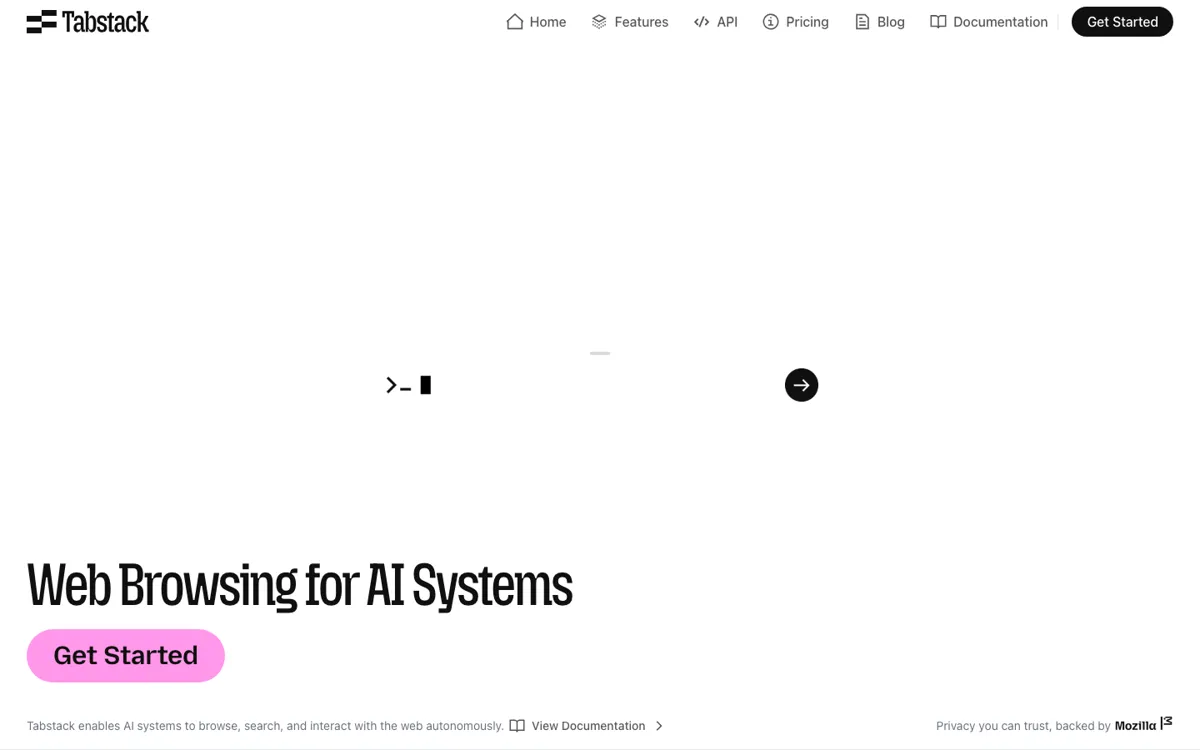
Tabstack sits below the finished app layer. It is most useful when your team wants live-web answers or browser actions but does not want to maintain search, page cleaning, citations, and progress streaming on its own.

The trust angle is better than a generic scraper because cited research, dedicated user-agent handling, and public pricing are already visible. The hard part does not disappear though: your product still needs rules for stale pages, weak domains, and conflicting claims.

What you can do with it

Run web research and return cited answers from one API call.
Extract a page into markdown, JSON, or a custom schema.
Generate messages or documents from live web data.
Automate clicks, forms, searches, and navigation in a browser flow.
Stream progress events while research or automation is running.

Technical details

endpoints
Four endpoints: Research, Extract, Generate, and Automate.
streaming
Research and automation can stream progress events.
sdk_support
Docs and SDK paths for TypeScript and Python.
site_controls
Uses a dedicated user agent and respects robots.txt opt-outs.

Top Alternatives to Tabstack Web Research

If Tabstack Web Research is close but still misses the job, try one of these instead.

Key Questions

Is Tabstack Web Research a consumer search app?
No. It is a developer API. Users get value after a team connects Tabstack to an app, agent, internal tool, or backend workflow.
What does the /Research endpoint return?
It returns live-web answers with source URLs and streaming progress. Teams should still test whether the citations are specific enough for their risk level.
Does Tabstack have a free plan?
Yes. New accounts get 10,000 free credits, and the Individual plan is $0/month with pay-as-you-go usage at $0.35 per 1,000 credits.
How does Tabstack handle website access rules?
Tabstack uses a dedicated Mozilla Tabstack User-Agent, honors robots.txt directives addressed to that user agent, and does not fetch content from sites that explicitly opt out.