VoxCPM Review

7.8/10

Open-source TTS model for multilingual speech, voice design, and controllable cloning.

Review updated June 2026 By The AI Way Editorial 3 min read
OpenBMB Open Source Self-Hosted Text-to-Speech Voice Cloning Free

Read this first

Treat VoxCPM as infrastructure, not a finished creator app.

Our Verdict

Pick VoxCPM when open weights and self-hosting control matter more than having a polished voice studio on day one. It gives builders a lot of room to shape the stack, but teams without Python or model-serving comfort will pay for that freedom in setup time.

Official site
Free to start.
open_in_new Try VoxCPM
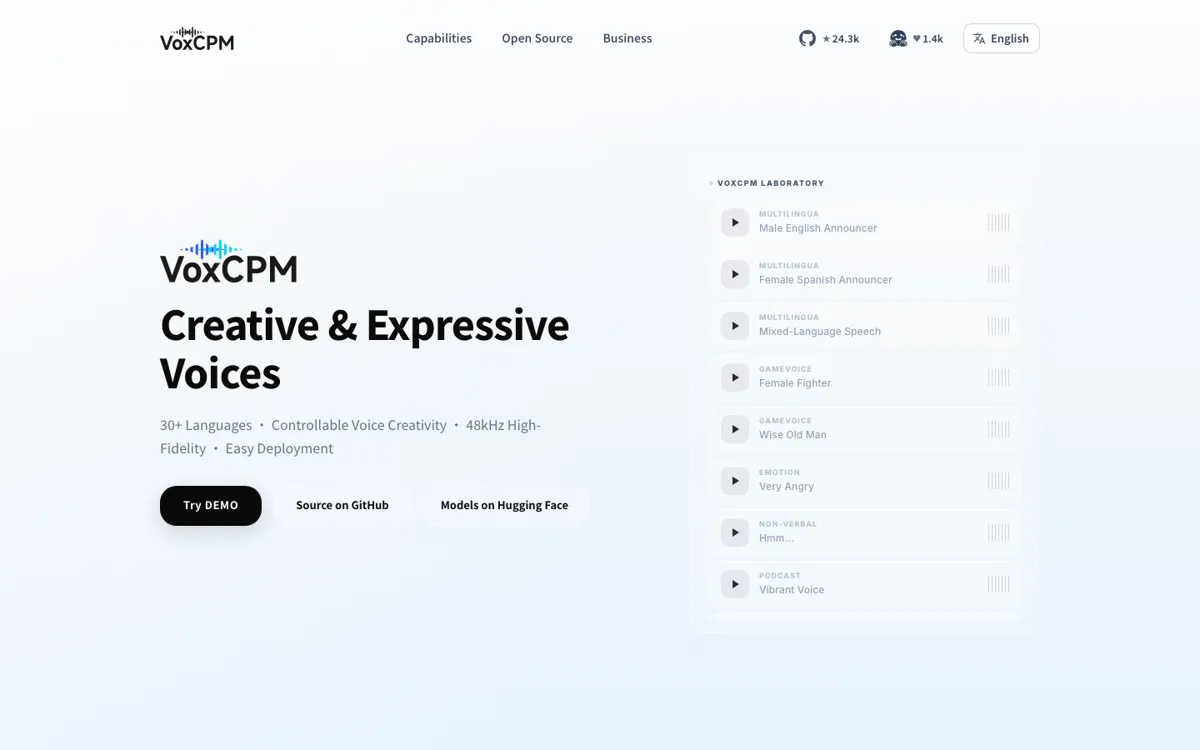
Official Website Snapshot Visit Site ↗

check_circle Pros

  • Voice design works even without recording a seed speaker.
  • Apache-2.0 licensing is friendly for commercial builds.
  • The serving paths are concrete enough for real product use.

cancel Cons

  • This is not centered on a polished no-code editor.
  • Long or expressive inputs can still need review passes.
  • Voice cloning safety and consent are your problem to govern.

Should you use it?

building a self-hosted TTS pipeline with multilingual output or controllable voice cloning

Skip it if: you need a managed browser voice studio with support, seats, and ready-made governance

Is it worth the price?

Free

The model itself is free. The real cost shows up in compute, engineering time, review, and abuse-prevention once the stack moves beyond demos.

The Free Tier

Free under Apache-2.0, with self-hosting costs

One thing to know before you start

Start with the hosted demos and sample pages first. If the base voice quality misses there, local setup will not fix the core fit.

What people actually use it for

Prototype multilingual app voices

Use it when one product needs several languages without locking into a managed vendor voice library.

Create character voices from direction

Text-based voice design is useful when early concepts need a voice before you record a reference actor.

Serve TTS inside a product

The NanoVLLM and vLLM-Omni paths matter when manual file generation is no longer enough.

What does VoxCPM actually do?

VoxCPM matters because it combines several capabilities that are often split across different voice tools. You can generate multilingual speech, design a voice from text, clone a voice from reference audio, and move toward real serving paths without giving up open weights.

The main risk is operational, not subscription cost. Once cloning and production use enter the picture, teams need consent rules, quality review, and someone who can own the runtime instead of expecting a one-click creator experience.

What you can do with it

Generate speech through Python, CLI, or local demos.
Design a voice from a text description.
Clone a voice from a short reference clip.
Use prompt audio for closer continuation.
Serve the model through NanoVLLM or vLLM-Omni.

Technical details

model_core
2B-parameter tokenizer-free TTS on MiniCPM-4
audio_stack
16kHz reference input and 48kHz output
serving_paths
NanoVLLM-VoxCPM and vLLM-Omni deployment routes
license_and_weights
Apache-2.0 code and weights
runtime_requirements
Python 3.10+, PyTorch 2.5+, CUDA 12.0 for main GPU path

Top Alternatives to VoxCPM

If VoxCPM is close but still misses the job, try one of these instead.

Key Questions

Is VoxCPM a SaaS voice generator?
No. It is mainly an open-source TTS model and toolkit with demos, docs, and deployment paths.
Can it design a voice without reference audio?
Yes. VoxCPM2 supports voice design from natural-language descriptions.
Can it be used commercially?
Yes, the code and weights are Apache-2.0, but teams still need their own consent and misuse controls.
What setup does it require?
Expect Python setup, local runtime choices, and GPU-oriented deployment paths for serious use.